OBSERVATORY & EQUIPMENT
Observatory
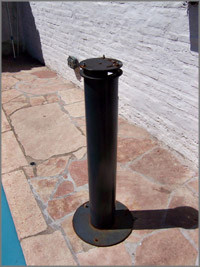
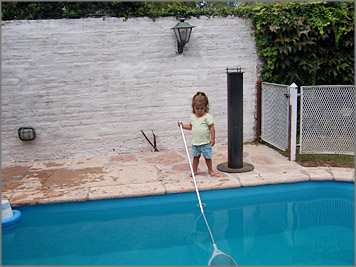
Well… that is the result after negotiations with my wife Silvina. Actually more than an observatory is just a site with a Pier at the border of the swimming pool in the house backyard. Although the location is a bit risky, it is a convenient place for the rig.
The pier is placed directly in the basement. There are a bunch of people who used to build a block of cement underground. That was too much and no space for discussion with Silvina. However the pear, is stable enough. An investment of something around us$ 100.- gave me all the stability the most expensive tripods might provide. Nevertheless l have to be careful not falling into the pool.
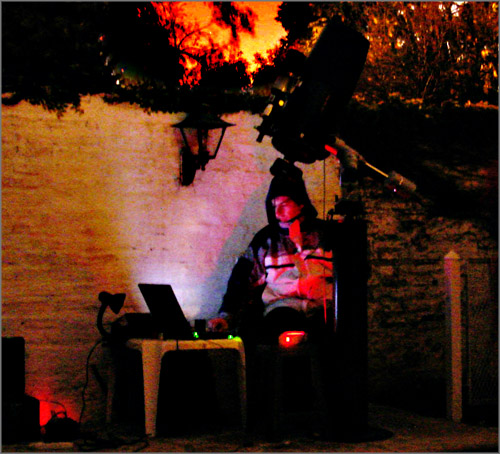
Agustina, our baby daughter, (center) is helping us with the swimming pool. On the right, Ruben Barros testing the Meade DSI Camera during the Pizza Star Party we had in March 2006. (Photograph courtesy of Sur Astroómico)
Location and Visual Magnitude
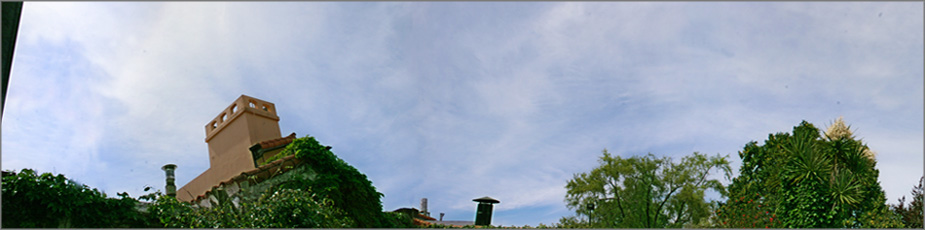
The backyard visual magnitude is approximately 4. In goods clear nights might reach 4.5 Not bad for suburban locations. My house is located in the City of Martinez some 25 kilometres north from Buenos Aires. The coordinates are lat -34.483; long -58.500.
Facing North - North West, I have Hippodrome of San Isidro. The place opens three to four times a week but usually closes at 10 pm. When lights are on, is impossible to do any kind of imaging. However after 10 pm the Hippodrome provides an extensive field with almost no city lights. I also have a reasonable east, but the South is a bit polluted up to Octantis. The panoramic picture shows the south side. The west is obstructed 30º from the ground, by a house next to my neighbour.
Telescopes
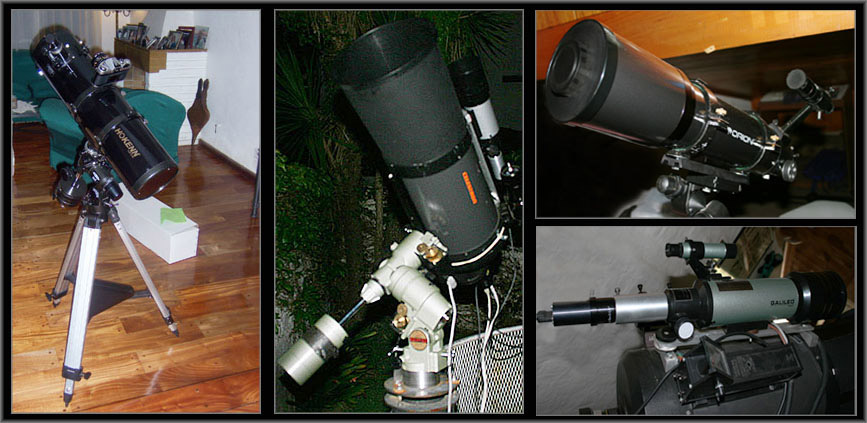
Synta 6 inches Newtonian
The typical exiting day !! My first telescope right out of the box. The reflex camera (piggy back) was just for the picture. This Newtonian with 750 mm focal length, is nice OTA for beginners like me. I started shooting with the Canon DSRL 300D. Not a bad combination for a starter, since the FOV gives something like 1.5 to 2 degrees. Synta provides also this OTA for Orion, SkyWatcher and some series to Meade and Celestron. I sill have it, and its short focal length suits perfectly the SXV M7 giving approximately a FOV of 29x23 arc minutes with a scale of 2.32 arc seconds per pixels.
Celestron SCT 8” (OTA only)
I was lucky to catch this scope in an auction sale through the net. The scope is in good conditions and also fits with the Vixen GPDX Mount. Due its 2 meters focal length the equipment is quite demanding. I generally use it with a Celestron 6.3 focal reducer / field flattener. However I expect to use it at f10 once my auto guiding capabilities starts to improve a bit more.
Orion ED 80
A two elements refractor OTA. According with S&T review this beauty is considered an APO instrument. Up to 200x has no difference with a Televue 76, however the mechanics are not comparable with the 76. Nevertheless this is probably one the best bargains in the market and definitely a good choice from non US or EU residents.
Synta 70/300
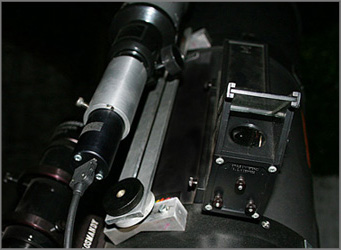
Small and cheap refractor used as a guide scope with the SXV guide camera. (showed at the centre with the SCT). The mentioned set up covers a wide field of view which is important to reach stars for guiding. However the focal length is too short and as a consequence, aggressive adjustments had to be set in the Astro Art CCD interface.
Synta 70/400
In order to improve a bit the preciseness of the guidance I also purchased this small achromatic scope for the Celestron SCT 8. As the 70/300 it has the advantage of being a light weight tube one of the priorities I considered at the time of adding extra weight to the Mount.
Mounts
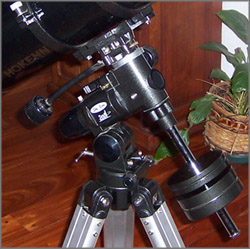
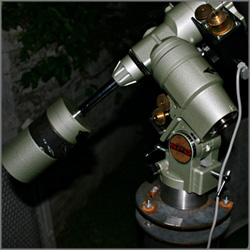
Vixen GPDX con Sky Sensor 2000 and DC-4 Motors
Quite an acceptable mount for the type of work I am doing. With the PEC correction enabled, the GPDX is capable to bring decent results for the Celestron SCT 8” at a focal length of 1.2 metres. The GPDX is able to guide from 90 seconds up to 120 seconds depending the cycle of the gears. With auto guiding and the proper adjustments it is able to guide over 10 minutes. The only weak point is the load capacity: 22 pounds or roughly 10 kilograms.
After reading carefully the Instruction Manual, The Sky Sensor 2000 controller was very easy to use. With one star align the mount is able to reach a target within 2 degrees of FOV after crossing the whole sky. For more precise pointing accuracy it is advisable to prfrom a second align with a star close to the target. Lets say 5 to 10 degrees. It will bring the object to a roughly 18 arc seconds field of view. The pad also brings a SAO catalogue of stars brighter than magnitude 4, which are quite useful for this approach.
EQ3 Synta
With good polar alignment the mount can track an object for about 45 and 60 seconds with reasonable results for a DSRL (big chip view3504 x 2336 pixels). Already adapted the pad with an SBIG ST4 interface for guiding with the SXV camera. I expect to use the EQ3 as a grab and go mount for meeting and star parties.
Cameras
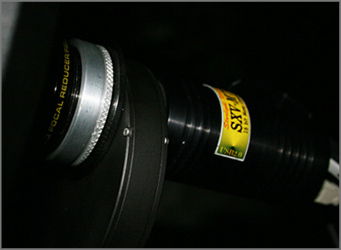
SXV M7 Starlight Xpress B&W
A good intermediate level camera. It carries a cooling system that bringsthe temperature 30º below ambient. Also has the capability of self guiding, but the exposure should last twice the time since half of the array is used for imaging and the other half for guiding.
SXV Guide Camera Starlight Xpress
Relative well priced camera for guiding. The SXV has the chip size of the SXV M5 but without the cooling system. It is designed to work with the SXV M7 or other cameras. With the guide scope gives a field of view of 42 x 24 arc minutes and it is able to track 9 magnitude stars. Using an off axis and the C8, is able to guide up to 11 magnitude stars.
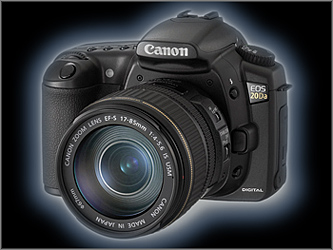
Canon 20 Da.
It has been discontinued in mid 2006. However it was a quite demanding product from the time it appeared in the market. Has more Ha light response (2.5 times) and also is less noisy compared with the models 300D, 350D. The emission band is filtered in 67%. In addition the pixel size is 6.4 microns. It also has some functions modes that allows see the screen at real time useful for fast focusing.