| HOME |
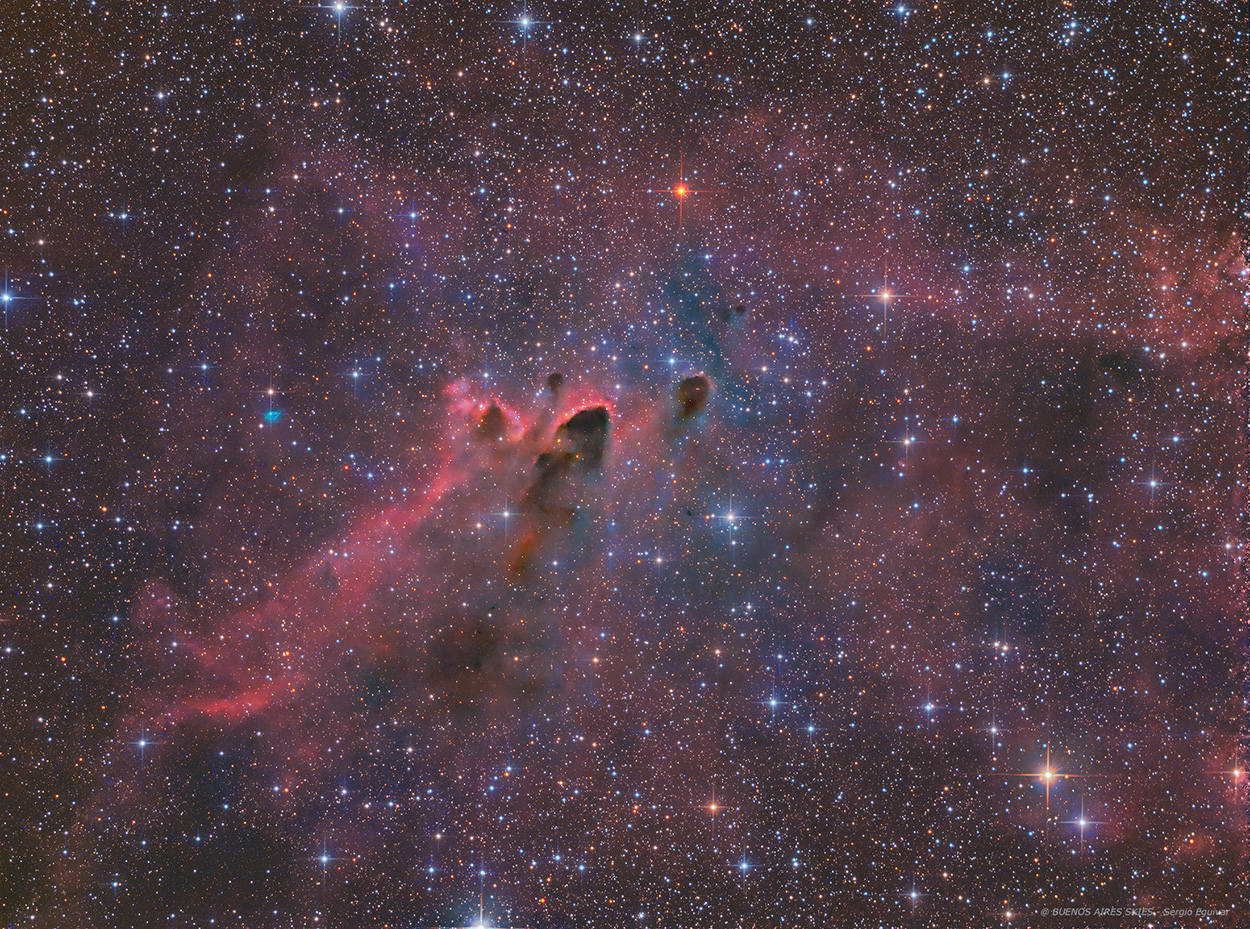
COMETARY GLOBULES 30 & 31
INTERSTELLAR DUST CLOUD IN PUPPIS (THE STERN DECK)
(Image centered at: ra 08h:08 m / dec - 35º 59')
CLICK THE IMAGE FOR A HIGH RESOLUTION VIEW
November 2025, Observatorio Cielos Albertnos, Buenos Aires, Argentina
DATA
TYPE: Cometary Globules
APPARENT DIAMETER: 30 x 50 arc minutes
APPARENT MAGNITUDE (V): n/a
DISTANCE: 1000 light years
IMAGE INFORMATION
INSTRUMENT: Orion Optics UK 6" Newtonian with Ultra Grade Optics working at f 5
CAMERA: QSI 583WS Mono Camera
MOUNT: SKY WATCHER NEQ6 Guided off axis with SX Lodestar Mono Camera
FILTERS: Baader LRGB Set & Antlia Ha 3nm O3 3nm
SKY CONDITIONS: Bortle 3 skies
OBJECT DESCRIPTION AND IMAGE SESSION
CG30 and CG31 are part of a Cometary Globule grouping located in Pupis and Vela within the Gum Nebula. The region is located roughly 1,000 light years away from us. Only discovered in 1976, Cometary Globules (aka CGs) are interstellar clouds that show a head ± tail morphology similar to the comets. The heads are compact and bright-rimmed. They are completely opaque so that no background stars are seen through them. A faintly luminous tail extending from the head generally points away from a nearby bright early-type star. Systems of CGs have been found in a number of star-forming regions with massive OB type stars. The complex also includes dark dust clouds and a Herbig-Haro object (HH 120), and shows signs of recent star formation within its head.