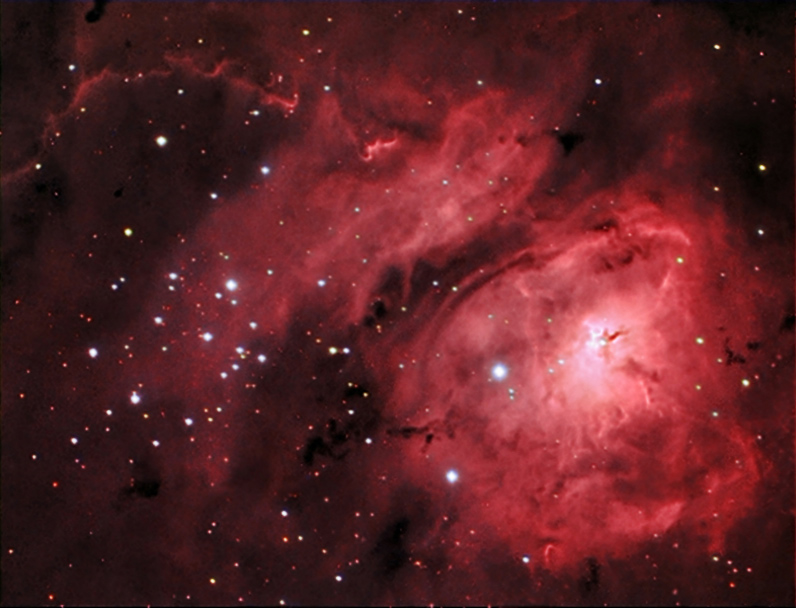
M 08 - THE LAGOON NEBULA
Sagittarius
(ra: 18:0.3:8 / dec -24:23)
DATA
TYPE: Emission and Relexion nebula
VISUAL BRIGHTNESS: 5.8
SIZE: 90 arcs minutes
DISTANCE: 5200 light years
OBJECT DESCRIPTION
The lagoon Nebula is one of the most remarkables objects not only in Sagittarius but in the whole sky. Comparable with the Orion Nebula in its beauty and brightness, it is visible with binoculars. this instrument allows to cover M08 completely. The Lagoon Nebula spreads along 90 x 40 arcs minutes (the size of three moons), The extension of M08 covers an area of 140 x 60 light years. The Hourglass Nebula is located in its center (visible in the image) and is an active star formation region. As usual happens in this type of objects the discovery came after a star cluster, in this case NGC 6530 in the year 1680 by John Flamsteed. Charles Messier catalogued in 1764.
IMAGE INFORMATION
SCOPE: Celestron C8 (SCT). Vixen GPDX. sky sensor 2000
SKY CONDITIONS: Bad. Moon at 25º. Thin clouds coming in. Unable to work with the Luminance channel
CAMERA: SXV M7 at roughly @ f6.3 (could be less...)
IMAGE ADQUISITION: AstroArt 3.0. CCD Controll Interfase 2.71
GUIDING: Synta 70/400 Refractor
FILTERS: Astronomik Ha 6 nm bandpass, Type II
EXPOSURES: R,HaR,GB (10,6,10,5,5)
PROCESSING: Calibrated darks, flats & bias in Images Plus 2.75. Adaptive Ritcharson Lucy for RGB. Post process in Photoshop CS
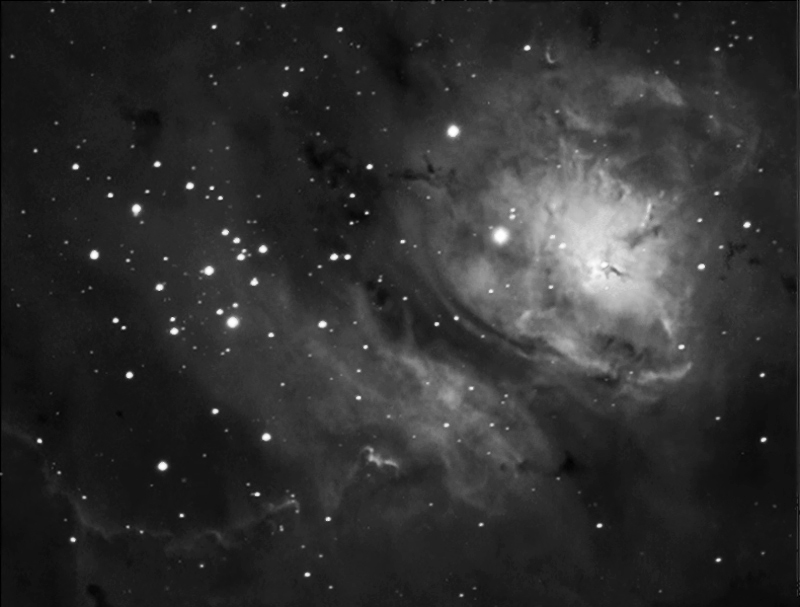
M 08 - THE LAGOON NEBULA
R,Ha Combination
Sagittarius
(ra: 18:0.3:8 / dec -24:23)
DATA
TYPE: Emission and Relexion nebula
VISUAL BRIGHTNESS: 5.8
SIZE: 90 arcs minutes
DISTANCE: 5200 light years
OBJECT DESCRIPTION
The lagoon Nebula is one of the most remarkables objects not only in Sagittarius but in the whole sky. Comparable with the Orion Nebula in its beauty and brightness, it is visible with binoculars. this instrument allows to cover M08 completely. The Lagoon Nebula spreads along 90 x 40 arcs minutes (the size of three moons), The extension of M08 covers an area of 140 x 60 light years. The Hourglass Nebula is located in its center (visible in the image) and is an active star formation region. As usual happens in this type of objects the discovery came after a star cluster, in this case NGC 6530 in the year 1680 by John Flamsteed. Charles Messier catalogued in 1764.
IMAGE INFORMATION
SCOPE: Celestron C8 (SCT). Vixen GPDX. sky sensor 2000
SKY CONDITIONS: Bad. Moon at 25º. Thin clouds coming in. Unable to work with the Luminance channel
CAMERA: SXV M7 at roughly @ f6.3 (could be less...)
IMAGE ADQUISITION: AstroArt 3.0. CCD Controll Interfase 2.71
GUIDING: Synta 70/400 Refractor
FILTERS: Astronomik Ha 6 nm bandpass, Type II
EXPOSURES: R,Ha (10,6)
PROCESSING: Calibrated darks, flats & bias in Images Plus 2.75. Adaptive Ritcharson Lucy for R and Ha Post process in Photoshop CS