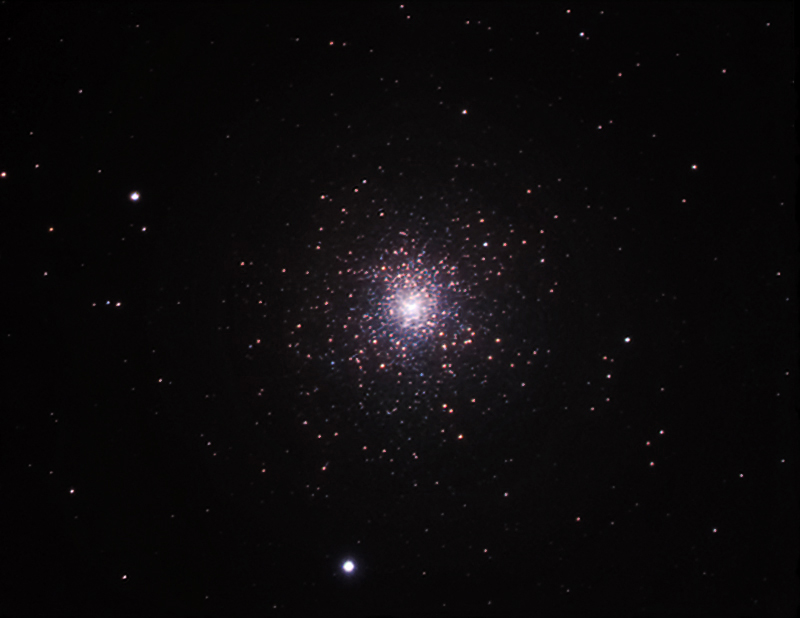
M15 – PEGASUS CLUSTER
Pegasus
(ra: 21,30.0 / dec 12:10)
DATA
TYPE Globular Cluster
VISUAL MAGNITUD: 6.4
SIZE: 12.3 arc minutes
DISTANCE: 33600 light years
OBJECT DESCRIPTION
M15 is a fine globular cluster that can be observed very well from the south hemisphere. Is linear extension is arround 175 light - years. Its brightest stars are about of apparent magnitude 12.6 it has also branch giants are about of magnitude 15.6. In medium size telescopes appears relative small about 7 arc minutes. M15's core is very small roughly 0.14 arcs minutes and has a contraction process "core collapse", which is common in the dynamical evolution of globulars.
It was discovered by Giovanni Domenico Maraldi in September 1746, while he was looking for De Cheseaux comet, and catalogued by Charles Messier in 1764. It was resolved as a globular star cluster by William Hershel in 1783.
IMAGE INFORMATION
SCOPE: Celestron SCT 8, Vixen GPDX with Sky Sensor 2000
GUIDING: Synta 70/400 refractor, SXV guidecam Astro Art Control interfase 3.72 Plug in
IMAGE ADQUISITION: Astro Art 3.0
SKY CONDITIONS: visual limit magnitude 4
CAMERA: Stalight Xpress SXV7at @ f6.3
FILTERS: Astronomik Type II
EXPOSURES: LRGB (12,12,12,12) 2 minutes subs
PROCESSED: Darks, bias (no flats), Ritcharson Lucy Deconvolution in Images Plus, Photoshop CS