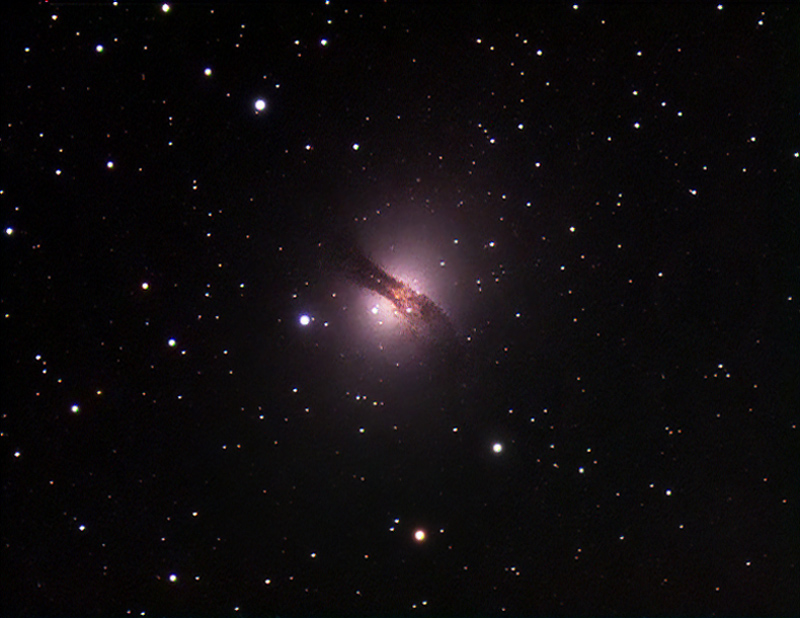
NGC 5128 - CENTAURUS A
Centaurus
(ra: 13:25.48 / dec -43:01)
DATA
TYPE:Eliptic Galaxy
VISUAL BRIGHTNESS: 7.6
SIZE: 18 x 14 arcs minutes
DISTANCE: 15 mio light years
OBJECT DESCRIPTION
NGC 5128 is the closest and bigger elliptical galaxy to our solar system and optically one of the brightest of our night sky. It has a particular structure because of it prominent rotational star and dust disc with a dramatic dust dark region that cross the galactic centre.
Centaurus A has a diameter of 60,000 light years and there is evidence that Centaurus A is the result of the collision of two normal galaxies. Centaurus A emits 1000 times more radio energy than our Milky Way. This is done in a bidirectional way generation big lobules that spans 800,000 light yeas in the intergalactic space. It was discovered by James Dunlop in August 1826
IMAGE INFORMATION
SCOPE:Orion ED 80 f7.5 Refractor
MOUNT Vixen GPDX. Sky Sensor 2000
CAMERA:SXV M7
GUIDING: Synta 70/300 SXV Guide Head
FILTERS: Astronomik Type II / Atik Filter Wheel
SKY CONDITIONS: visual magnitud 4. Half Moon at 34 degrees. Object too low in the west and running out of time.
EXPOSURES: LRGB (30,5,5,5) Subs 300 secs
PROCESSING: Calibrated darks, flats & bias in ImagesPlus 2.75. Photoshop CS