| HOME |
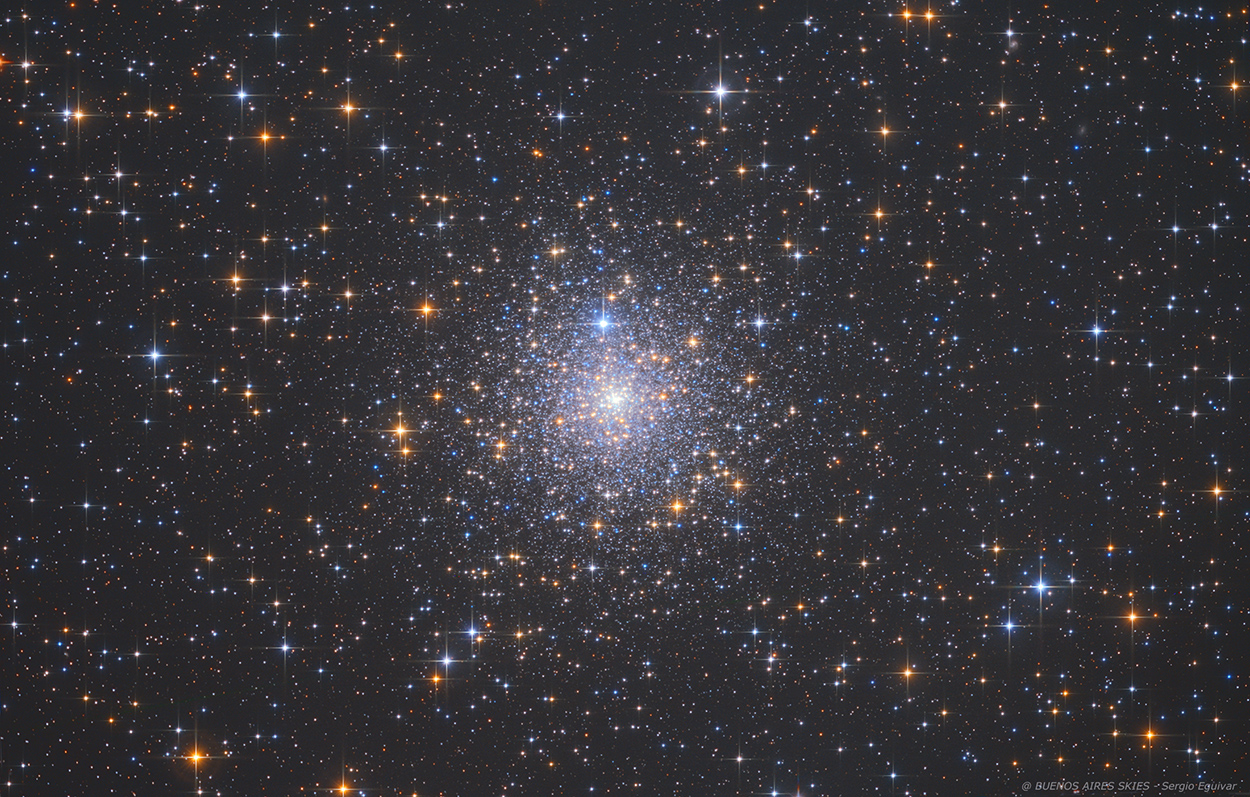
NGC 6752
GLOBULAR CLUSTER IN PAVO (THE PEACOCK)
(Image centered at: ra 19h:10 m / dec -59º 59')
CLICK THE IMAGE FOR A HIGH RESOLUTION VIEW
ANNOTATED IMAGE 100% RESOLUTION
JUNE 2026, Observatorio Cielos Albertnos, Buenos Aires, Argentina
DATA
TYPE: Globular Cluster
APPARENT DIAMETER: 20.4 arc minutes
APPARENT MAGNITUDE (V): 5.4
DISTANCE: 13.000 light years
IMAGE INFORMATION
INSTRUMENT: Orion Optics UK 6" Newtonian with Ultra Grade Optics working at f 4.5
CAMERA: QHY 183 Mono Camera
MOUNT: SKY WATCHER NEQ6 Guided off axis with QHY 5II Mono Camera
FILTERS: Baader LRGB Set
SKY CONDITIONS: Bortle 3 skies
OBJECT DESCRIPTION AND IMAGE SESSION
NGC 6752 (also known as Caldwell 93 and nicknamed the Great Peacock Globular Cluster is a globular cluster in the constellation Pavo. It is the fourth-brightest globular cluster in the sky, after Omega Centauri, 47 Tucanae and Messier 22, respectively. It is best seen from June to October in the Southern Hemisphere. It is also known as NGC 6777, though this identification is uncertain. NGC 6752 was first identified by Scottish Astronomer A James Dunlop on 30 June 1826 from Parramatta Australia, who described it as an irregular bright nebula which could be resolved into a cluster of many stars, highly compressed at the centre.
It has a core region densely populated with stars around 1.3 light-years in diameter, which indicates it has undergone core collapse. The cluster lies around 13,000 light-years distant and is one of the closer globular clusters to Earth. It also lies 17,000 light-years away from the galactic centre. NGC 6752 belongs to Shapley–Sawyer Concentration Class VI, namely of intermediate density, and has been calculated to be 11.78 billion years old. There are many binary stars in the system, as well as blue stragglers, which are likely to have been formed by collisions and mergers of smaller stars. The apparent magnitude of the cluster is 5.4, so it can be seen with the unaided eye.However this depends on good viewing conditions with a minimum of light pollution. With binoculars it can be seen to cover an area three quarters the size of the full moon. It lies 1.5 degrees east of 5th-magnitude Omega Pavonis. The nearest bright star is Peacock, which lies 3.25 degrees north and 9.25 degrees east.
NGC 6752 - ANNOTATED IMAGE 100% RESOLUTION
GLOBULAR CLUSTER IN PAVO (THE PEACOCK)
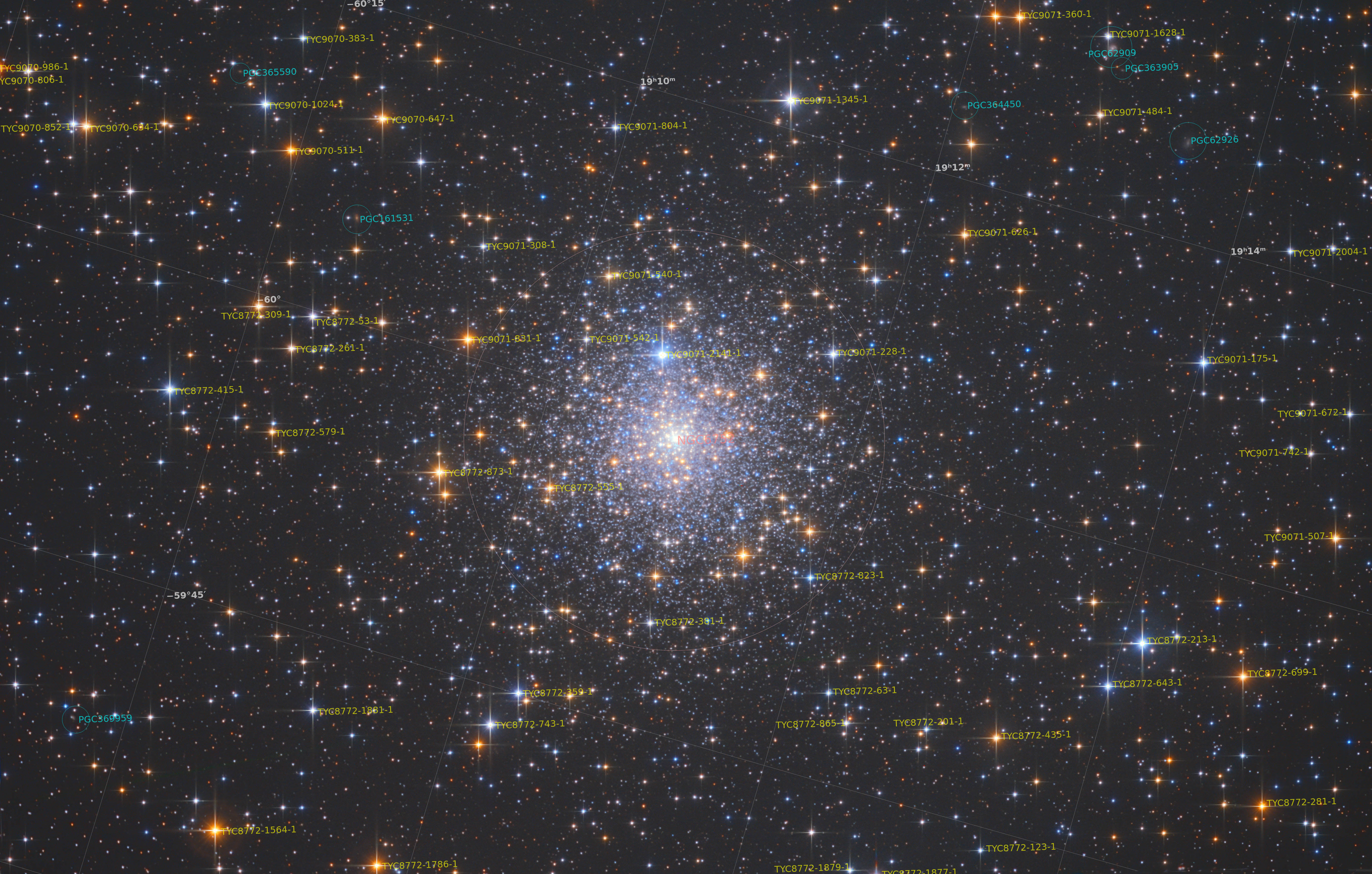
Image Plate Solver script version 5.6.2
===============================================================================
Referentiation matrix (world[ra,dec] = matrix * image[x,y]):
+1.93948568e-04 +6.41539948e-05 -6.55797062e-01
-6.41163226e-05 +1.94011537e-04 -1.79638798e-01
WCS transformation ....... Linear
Projection ............... Gnomonic
Projection origin ........ [2771.999886 1841.999931] px -> [RA: 19 10 53.134 Dec: -59 59 57.96]
Resolution ............... 0.736 arcsec/px
Rotation ................. -161.715 deg
Reference system ......... ICRS
Observation start time ... 2026-06-15 06:28:56 UTC
Observation end time ..... 2026-06-15 06:31:56 UTC
Geodetic coordinates ..... 58 31 05 W 34 29 19 S 50 m
Focal distance ........... 673.05 mm
Pixel size ............... 2.40 um
Field of view ............ 1d 7' 57.6" x 45' 9.6"
Image center ............. RA: 19 10 53.134 Dec: -59 59 57.96
Image bounds:
top-left .............. RA: 19 05 36.694 Dec: -60 10 21.09
top-right ............. RA: 19 14 17.763 Dec: -60 31 54.48
bottom-left ........... RA: 19 07 35.018 Dec: -59 27 42.29
bottom-right .......... RA: 19 16 06.157 Dec: -59 48 48.03